
Tech’s Search for Legitimacy
As tech's power grows, so must its ability to build status with the rest of society

This was originally posted on my personal website.
Founder status markers have progressed over the past decade as the startup ecosystem has recognized the importance of industry perception within tech. There is still an open question of how much how the rest of society perceives tech should matter.
In broad strokes, these markers started off focused on financial capital via fundraising ability (amount -> pace -> valuation)1 and social capital via investor signaling in which who led your round didn’t matter, then really mattered, and now barely matters.2
With the explosion of AI startups and quick-ramp traction, founder status has recently moved towards “real money” markers such as run-rate revenue and most recently revenue-per-employee to signal efficiency. That said, there is some suspicion/insecurity that all of this ARR might be temporary and so status has now moved to the ability to secure tender offers in order to signal “we can make you rich” towards talent and “we can take in more capital” towards investors.3
Once again, all of these are insider status games happening at a time where merely being a founder is devoid of/declining in status. Founders can create influence and eventually produce enormous power, but they do little to determine whether that power is admired outside of tech or viewed as legitimate now that tech is in the zeitgeist for reshaping the rest of society.
I guess comparison eventually comes for everyone, and ambitious people often carry a fear of becoming shooting stars in which they are noticed, then forgotten, without anything about them having changed.4
Status = Being Out of Distribution
One way to think about why these markers keep changing is that status is ultimately a claim to being outside the distribution. Novelty breeds curiosity which can compound into status. Eventually though, novelty gets absorbed into the distribution and loses power, becoming descriptions of the average “successful” founder rather than evidence of something unusual and special.
The speed of this decay depends on how easily the behavior can be copied and once founders know which signals matter, they move towards optimizing for them.
Within tech this is most widely exemplified by the consistent waves of status that cycles through working at various companies, whether it was the erosion of status via working at a Google or Meta instead of a YC startup in the 2010s, or the increasing default-state of everyone going to work at a frontier lab in 2026.
Despite the cycles, there are a few evergreen status markers invert this dynamic and compound as they spread. This can look like idea moats that others adopt and enter into the tech lexicon5 as well as talent mafias that repeatedly produce significant companies.
These markers endure because they are downstream of some sense of unusual judgment or ability, rather than behaviors that can easily be copied. More interesting, though, may be status markers that are difficult to absorb into the distribution at all because copying them requires accepting a real cost.
Status via Sacrifice
As efficiency becomes increasingly cheap via AI, certain levels of performance may become less differentiating.6 The next generation of status markers may therefore be focused less on pure output and more on what one is willing to give up in pursuit of greatness, or even the patience required to do so.
One way to think about status outside of tech is:
What can founders do that shows they are different from what society believes someone like them would do, while conveying that they “get it”?
Much of this will happen through how they build their company, but some of it should happen through what they choose to build, support, or participate in beyond it.
On Talent & Employeemaxing
The most observable version of status via sacrifice is eliciting sacrifice from talented people; convincing someone to walk away from vesting equity for unvested equity in yours, a trade that gets more valuable the more money-obsessed tech becomes.
Looking forward, a possible counter-trend to the Current Thing of labor efficiency could instead be increasing status for founders that show a desire to scale hiring of humans within their organizations or a willingness to hire many junior employees. A sacrifice of margin or perceived AI-nativeness perhaps.7
This type of status compounds within tech (talent begets more talent) and could accrue even more value outside of it.
Employeemaxing could create natural goodwill with society as a counterposition to the main narrative of AI (labor displacement), especially if the employment spans multiple geographies and not just coastal elite cities.
In times of change or fear, employeemaxing founders could be a beacon of inspiration, which is inherently status-accruing.
The Progression of Status
The two examples above on talent refer to motions that accrue insider status as well as more horizontal societal status in a very simple way (give the people what they want, what they want is money/jobs).
At risk of turning this into even more of a sociology essay, it is useful to disentangle a few related concepts surrounding power and status, while introducing legitimacy.
Power is the ability to make people respond to you whether or not they particularly like you.
Insider status is the belief within an industry (in our case, tech) that you are exceptional.
Horizontal status is whether that judgment travels into parts of society that do not care about or actively dislike traditional insider status markers.
Legitimacy is whether people ultimately believe the power that followed should be allowed to endure, an increasingly difficult proposition at what appears to be an all-time low in societal trust.
These obviously blur together, but most importantly they are not always a linear progression.
Insider status can compound into immense power without drawing status outside of tech or broader societal legitimacy.
A founder can also have plenty of institutional acceptance from governments or a section of the working class because they are viewed as necessary despite not being horizontally high status.8 Tech has been very good at creating this sense of dependence while not drawing mass appeal over the past decade.
The more interesting forward-looking question is therefore not which markers founders will optimize for next inside tech but what allows power to progress into status outside of it and, for at least some founders, what actions allow them to achieve this beacon of legitimacy.
We thus must naturally look at various types of impact.
Institution Building and Philanthropy
Historically, some of the most revered or remembered founders didn’t stop at company building. Their companies created initial wealth and influence, but over time this expanded into universities, foundations, museums, research institutes, public spaces, and all of the other institutions that allowed their presence to be felt beyond their company’s sphere of influence. While this scale is not necessary to accumulate non-tech status, in today’s world the ethos of it likely is.
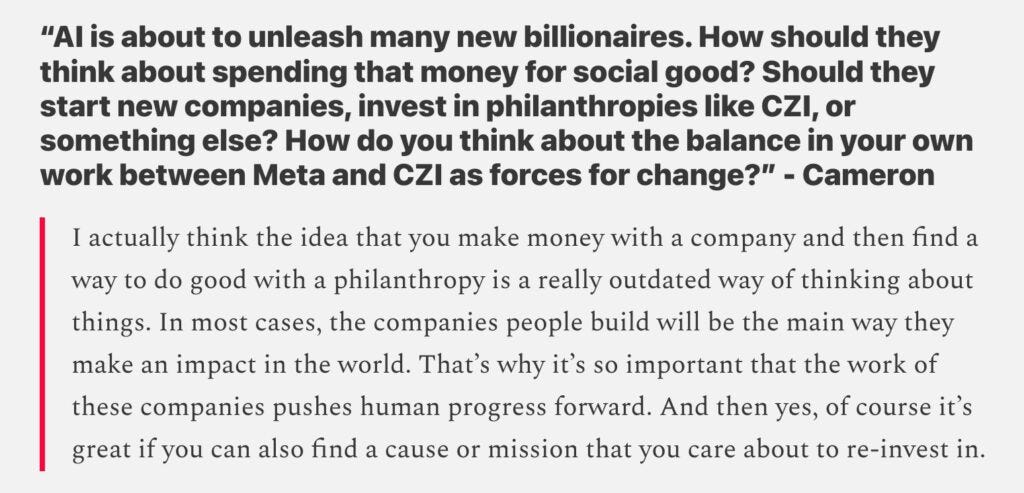
This often rings hollow in tech as many founders today view their companies as the core vessel through which they will impact the world. This is reasonable as many of the largest companies do have societal impact that far outweighs any scale of grants or government spending.
In addition, the dynamics of today’s leaders are different than the prior generations, as founders today become powerful in their 20s or 30s and may remain so for another 50+ years. There may not really be an epilogue to their careers but instead a parallel track running alongside their company which means the progression from power to status to legitimacy, if it happens at all, now plays out in public while the company is still being built. This is why it is important to build legitimacy, as it allows founders to impact the world for long periods of time in a relatively unencumbered way.
This matters at a time when tech is facing unusually broad distrust and political hostility and AI has created an air of villainy around founders and our lovely industry, regardless of merit. Confusingly to me, backlash still seems at times to catch founders off guard, even though today’s cohort has in some cases seen it arriving in advance and should probably use that notice strategically, as the AI lab leaders have done.
Put another way, while the AI labs are annoying to some because they keep telling everyone they are going to be unemployed soon...they are trying to tell you that you are going to be unemployed soon to help you!9
Give Away The Money & The Control
It is the function of art to renew our perception. What we are familiar with we cease to see. The writer shakes up the familiar scene, and as if by magic, we see a new meaning in it.
The Novel of the Future, Anais Nin
Philanthropy is an interesting word that is getting talked about a lot recently, but often in a very specific way in tech circles as people reconcile with hundreds of billions of dollars of windfall (maybe) and post-AGI timelines/worlds being debated.10
I was at a philanthropy-focused event in SF recently which featured some of the more thoughtful discussion I had seen between a more Effective Altruism-aligned panelist and a skeptical professor. Despite ~2 hours of conversation, the most interesting part to me was the words “culture” and “art” were not mentioned once.11
If I were to distill the differences between tech versus non-tech philanthropy simplistically, it would be that tech often looks at philanthropy in a similar way that it looks at company building, with characteristics of discrete financing events, scalability, measurement, first-principles thinking, and ideally some self-sustaining mechanism that signals the people are properly allocating capital.12
Non-tech philanthropy on the other hand has a very clear contrast on “culture” where support for the arts is nearly nonexistent in tech mainstream zeitgeist,13 but remains a core aim in non-tech and East Coast circles as is readily apparent if you wander through any art museum or gallery and notice mostly finance names on the plaques.
The reason for this split is possibly just classic old money vs. new money debates, but may get at something deeper which is that the finance industry has never attempted to at-scale claim to being good for anyone. Because of the lack of attempted impact narrative, the finance industry very clearly realized it needed to find new ways to use its capital to impact society outside of the company-as-a-vessel-for-good thesis. Tech has for many decades held the opposite claim, which has worked until recently, and thus has not really needed to build the same muscle or motion.
Both are important, but my sense is that on a go forward basis, tech may overestimate how directly the quantitative societal value something creates correlates into amount of horizontal status accrued. Not all philanthropy is considered equal from a horizontal societal-status point of view.14
Many missions are high-status within tech because their ROI is clear and yet barely hit outside of tech even when the benefactors clearly show the value of solving a given problem (lives saved, dollars saved to some government system, etc.). What we have learned over the past decade is that very few things make it into the societal lexicon and there are only so many slots across “types” of problems that can be cared about at wide scale.15
A way to understand all of this is that almost any good done through a company receives a narrative discount because it remains attached to shareholder value and self-interest or is overshadowed narratively by anything the company does for capitalistic purposes. A company can create enormous societal value and still fail to control the story people tell about why the company matters or what the founder stands for.
This ideologically helps explain part of tech’s rising obsession with PR, podcasts, and its own media apparatus, as we increasingly push content that looks/feels like and integrates well with the content diet of the average citizen.16
To bring it back to the prior progressions, this dynamic of “lack of meritocracy in status” constrains horizontal status, not power.
A sufficiently important company can force people to adapt regardless of how they feel about its founder; it just may not make them think more highly of the founder while doing so.17
Life is for lessons and one lesson from the prior Carnegie class is that enormous private power eventually has to show up in public life in some form. The generous framing is endearment through philanthropy. The more cynical one is pacification.18
Thus, we should be asking:
What can a founder do that makes people believe their city, culture, or institutions are better because they exist?
As always, we go back to vibes.
While the ROI of cultural institutions is hard to quantify, it is clearly net good for society for them to exist and the vibes are great despite no blindingly obvious19 direct value for the financial class allocating resources to it.
For a tech founder today, building or supporting any of these institutions or, at a smaller scale, committing to a city, cause, or community they actually care about, shows a willingness to participate in a part of society they do not entirely possibly understand best, and to spend money, time, and attention on things whose value cannot always be quantitatively explained.
It is even better if they relinquish control and decision-making in these efforts, and to tie it back to our prior question to be answered, it shows an understanding of getting it. With a founder implicitly/explicitly saying, you know better than me, and accepting that technological success does not confer universal judgment and that not every institution needs to be first-principles reasoned back toward the founder’s or tech industry’s preferred outcome.
It is out-of-distribution for what society expects them to do and, for now at least, should work when it feels real.
On Authenticity
There is a somewhat annoying circularity to this essay and to talking about status and perception.
The more transparently something is optimized to create a specific perception, the less durable the resulting status tends to be.20
With that said, nothing is pure. Founders already learn to pseudo-authentically signal personality through how they build: ambition, intensity, judgment, toughness, and all of the other adjectives that get attached to them. But perhaps most importantly is that the elite class, of which many founders find themselves in, are increasingly dehumanized and thus also have a burden to convey that they are actual people outside of the companies they are building and that whatever philanthropic endeavors they are engaging with seems aligned with their personal values.
Why Does This Matter?
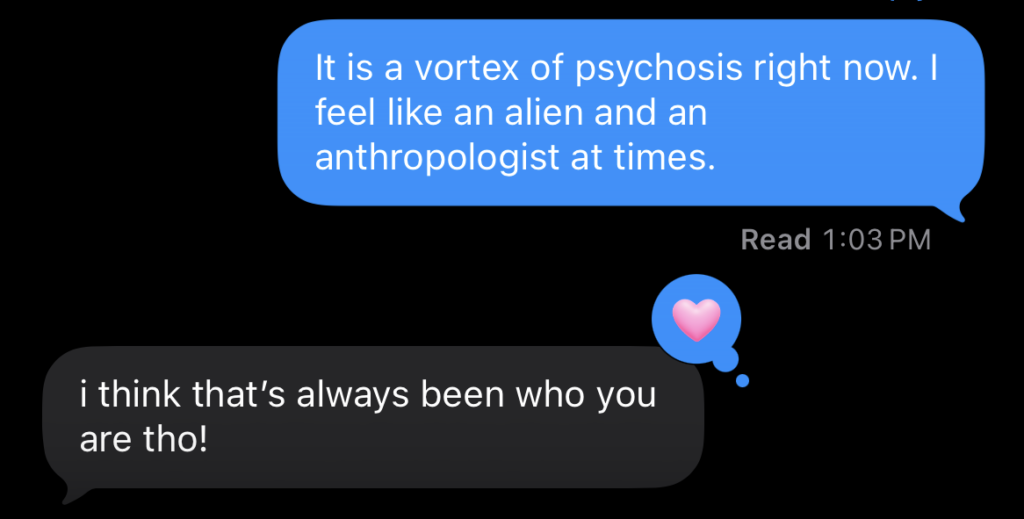
For whatever reason, my feeling is that our industry doesn’t seem worried about how it is perceived externally nearly enough. And perhaps that is the only punk rock thing left about tech and something that some would say we should continue to not worry about. Adjacent to this train of thought is the Secret Congress theory which effectively states that the best progress is made outside of the public consciousness.
A founder can say fuck off I do not care about the need to be liked outside of my people, build something important enough, and force society and governments to adapt around it, producing power and institutional acceptance without much horizontal status or societal legitimacy. This has worked in some forms in the past decade, however it feels less likely it is the best path forward, and instead we are seeing more of the industry testing a middle ground via buying political access directly through donations, PACs, and proximity to whoever holds office. We all await mid-terms and 2028 to see how this continues to progress.
So why does any of this matter?
There is a rising fringe-consensus belief21 that eventually pitchforks will come out and that tech will be the scapegoat for a decade of k-shaped economies moving further apart and parts of society feeling left behind.
Tech’s implicit defense is that it sees the future first, and in many senses this is often true. Our industry generally understands who and what could change the world before society does, and history has rewarded that belief plenty of times.
But perhaps this moment is different amidst the political, societal, and technological backdrop that we find ourselves in. Perhaps the persistence of tech dominance can also create a dangerous kind of tunnel vision in which seeing very far in one direction is mistaken for seeing everything. Correctly anticipating the future does not necessarily mean understanding the humans, cultures, and institutions that have to live through its arrival and thus far there haven’t been strong views on how to meet people where they are, instead of making them understand the world we are building for them. We can be very correct about why something important will change the world, but very incorrect about how the world will internalize that thing.
This is only exacerbated when we think about the increasingly tight cycles of change the world seems to find itself in. Political coalitions change, norms and vibes reverse, and what made someone admirable to one era can look quite different the next. Legitimacy allows power to survive those reversals and gives founders room to act, and even to be wrong, without immediately losing the right to continue acting.
And thus founders, and our industry broadly, must be continually evaluating and re-evaluating what earns legitimacy in order to survive across these cycles.
Of course, again, one can opt to not play this game and take their chances, but this would be somewhat antithetical to the declaration of wanting to change the world that comes from our industry broadly.
It would be bad for tech, and probably for the rest of the world, if it became more culturally and socially isolationist at the exact moment it gained the most power over culture and society. Power that can only be appreciated within the insider status system that produced it will likely come under fire as influence expands beyond that system and meaningfully cascades through the world. Especially if those outside the system believe they are repeatedly collateral damage.
“It’s all a question of imagination. Our responsibility begins with the power to imagine. It’s just like Yeats said: In dreams begin responsibilities”
Kafka on the Shore by Haruki Murakami
Thank you to Asad, Andy, Kevin, and Maran for thoughts
(we raised money) which progressed to amount (we raised a real amount of money) and then led to a combo of pace of amount (we raised a huge seed round) and valuation (we raised money at a higher valuation than others). People are even engineering rounds to have dual valuations such that they can publish the higher one. I long for the days we didn’t talk about valuations
We can call this “social capital transfer where at first investors didn’t matter (people didn’t really know what VCs were), then they really mattered (we raised from insert firm that communicates thoughtfulness), and now they matter maybe less than ever, both because VCs invest in everything, including competing companies, and also because VCs are viewed as kinda lame across the board.
In many ways, tender offers signal another tier of company that has so much demand, people are willing to buy common stock and founders don’t need to take dilution. A good status signal that 180’d relative to a decade ago when secondary was generally viewed as mixed at best and reserved only for founders.
At times I wonder if the psychosis and nihilism I see in builders is downstream of this, both worrying the work is worthless if OpenAI/Anthropic/et al steamroll them, and everyone now being a “founder” in some form grappling with the status collapse outside of tech.
Think writing essays like Machines of Loving Grace or coining terms like Founder Mode or Move Fast and Break Things
Those absurd discussions annoying people on Twitter have every few weeks about how going from $1m to $5m ARR is JUST NOT GOOD ENOUGH ANYMORE.
We are already seeing this in the AI Lab fight, most recently in the reflection of Thinking Machines’ manifesto that paints a far more pro-humanism and human-enablement future than their competitors, which was quickly followed by an open-weight model release, and sure enough the vibes were great.
A very current version of this is the federal government increasingly speaking in tech speak in the Science: A New Golden Age paper.
Right? That’s why they are saying it? Right? Right?!
I highly recommend reading Nan’s now seminal piece.
In fairness, one of the parting words was to go fund new schools.
There is something different as well which is more cynical in that often the tech world seems to believe we have answers for every problem, where finance world often seems to allocate towards people who have answers and understand zones of competence better. I know this is a contested point but I think worth throwing into the ether and we will come back to it.
Yes, some people mention New Aesthetics now
It is important to note this is not a black and white framing and these institutions are not morally pure, often with their own gatekeepers, power-grabbers, etc., and in the cynical framing, a rich founder can buy a plaque and try to convert technological power into older cultural power. New money vs. old money is not a novel concept and tech has done a good/cringe job trying to figure this out as best evidenced by this year’s Met Gala.
Conversely, people only have the capacity to be annoyed by so many things. Politicians seem to understand this better than ever before, as they use war, markets, and who knows what else to perpetually shift outrage such that it can never build.
Some just say “fuck those people” and call it new media maybe?
Shout out Zuck who somehow manages to get people to hate him in different ways every few years despite being a generally “good” guy who married his college sweetheart, loves his kids, and posts endearingly dorky videos of him bbqing.
Though, for what it’s worth, Carnegie’s points from The Gospel of Wealth also basically say that rich people were the superior allocator of capital.
Again, there definitely is value and plenty of jaded/reasonable takes here on what it means to buy support from industries.
But maybe I’m wrong because admittedly, I continue to be blown away by the fact that people accrue status from AI-slop essays on Twitter on a seemingly hourly basis.
Intentionally phrasing it this way because it’s one of those things we all kinda believe and only some very much believe. Hanauer wrote a warning of sorts back in 2014 in The Pitchforks Are Coming… For Us Plutocrats, so the fringe half is over a decade old, with consensus rising over the past decade.
been thinking about our philanthropy discussion a lot
Wow! 😍